Vaseline did not plan to become BASELINE. A Korean skincare creator said the brand name differently, the internet picked it up, and Vaseline decided to embrace it.
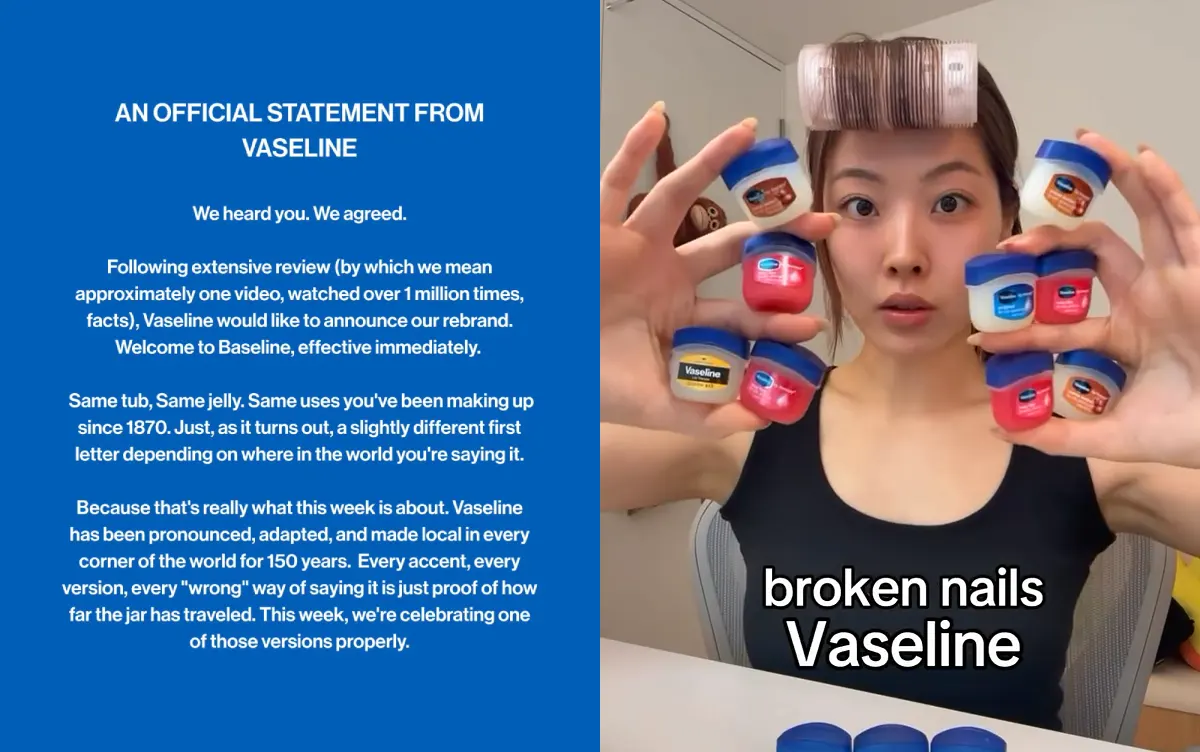
The Vaseline BASELINE campaign began with Min Day Lee, a South Korean creator known for her skincare content. In a video showing her collection of Vaseline products, Lee repeatedly pronounced the brand name in a way that sounded like “Baseline”. The pronunciation quickly became the focus of the video, spreading across social media and evolving into “Bassline” as users began creating their own versions, memes and remixes.
For Vaseline, this was not a campaign waiting for a media plan. It was a live piece of internet culture that had suddenly attached itself to the brand.
The response was unusually direct. Vaseline changed elements of its social identity to BASELINE, created mock packaging and announced a tongue-in-cheek rebrand. What could have been a passing viral joke became a carefully extended social media campaign.
How the Vaseline BASELINE Campaign Started
The original video worked because the pronunciation felt natural rather than staged. Lee was not trying to create a viral advertising moment. She was simply talking about products she already featured in her skincare content.
Lee later explained the pronunciation in another video, connecting it to the way English sounds can be adapted when spoken in Korean. That gave audiences more context, but by then the original pronunciation had already become the joke.
The audience took over from there. “Baseline” became something people could repeat easily, while “Bassline” gave the trend another form to play with. The conversation moved beyond skincare and into broader social media culture.
Vaseline recognised that the opportunity was not to correct the pronunciation. It was to make the pronunciation part of the brand’s communication.
That decision gave the campaign its starting point.
Vaseline Officially Welcomes BASELINE
The brand then took the joke much further than a typical social media response.
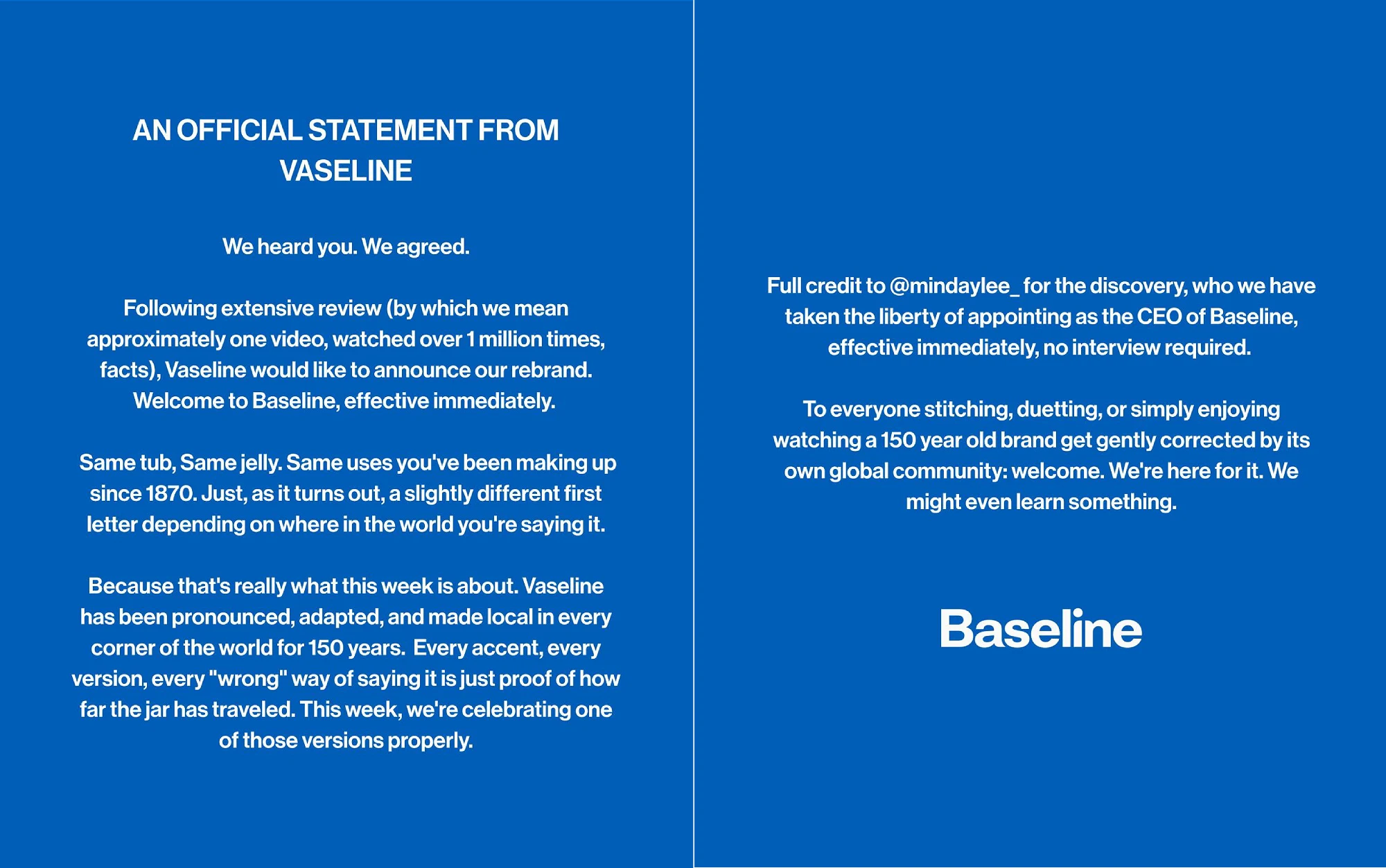
Vaseline issued an official statement beginning with, “We heard you. We agreed.” It announced that, following an “extensive review”, which the brand jokingly described as approximately one video watched over a million times, Vaseline was becoming Baseline with immediate effect.
The statement made another important point: “Same tub, Same jelly.”
The product had not changed. The name had.
The brand explained the joke by pointing to the different ways Vaseline has been pronounced and adapted around the world. Vaseline’s own history dates the brand to 1870, giving the 150-year reference in the statement a real connection to the brand rather than making it purely part of the joke.
That gave BASELINE another layer. It was still a social media gag, but the brand used it to celebrate the way people have made the name their own in different places and accents.
The tone was deliberately self-aware. Vaseline was not pretending that a genuine corporate rebrand had taken place. It was using the language and formality of a corporate announcement to make the joke bigger.
Min Day Lee Becomes CEO of Baseline
Vaseline also made sure the creator behind the original moment received full credit.
The brand announced that it had taken the liberty of appointing Min Day Lee as “CEO of Baseline”, effective immediately, with “no interview required”.
It is a small detail, but an important one.
Instead of taking the viral idea and rebuilding it entirely around the brand, Vaseline kept Lee visible. The person who unintentionally created the moment became part of its official continuation.
That approach fits a broader shift in creator-led marketing. Creators are no longer only useful for delivering a brand’s finished message. Their own behaviour, language and communities can become the starting point for an idea.
Here, the campaign did not need to manufacture authenticity. It already had an original creator at its centre.
From One Viral Video to #VaselineHijacked
The campaign did not stop with Lee.
Vaseline expanded the idea through its “Vaseline-Verified Hijack Icons” initiative, recognising creators who contributed to the conversation. The brand also invited its wider community to create their own “Bassline” interpretations using #VaselineHijacked.
This was an important shift in the campaign.
The original moment belonged to one creator. The next stage gave other people permission to participate.
That helped turn the BASELINE idea from a single viral post into a community-led social media campaign. Users were no longer simply reacting to what Vaseline had done. They were given a format they could adapt themselves.
For a brand, that creates more possibilities than simply publishing another reaction post. The audience becomes part of the content system.
Why the Vaseline Rebrand Works as Reactive Marketing
The smartest part of the Vaseline rebrand is that it did not try to make the original moment look planned.
Pratik Ved, VP Skincare at Hindustan Unilever, summed up the thinking behind the response: “We didn’t create this moment; the internet did. Our job was to simply show up.”
That is a useful distinction.
Many brands try to turn viral conversations into polished advertising as quickly as possible. The danger is that the response can feel like an interruption. The audience created the moment, but the brand suddenly behaves as though it owns it.
Vaseline took a different route. It acknowledged where the joke came from, gave credit to Lee and then built new layers around the idea.
The humour also stayed close to the original conversation. There was no complicated product message attached to BASELINE. The altered name was enough.
That simplicity helped the campaign travel.
What BASELINE Says About Modern Brand Participation
The Vaseline BASELINE campaign is ultimately less about changing a name and more about changing the way a brand responds to its audience.
Vaseline is an established global skincare brand with a name that has been around since 1870. It could have been protective about a pronunciation that differed from the official version.
Instead, the brand treated the variation as something worth celebrating.
That does not mean every viral joke deserves a brand response. The opportunity worked here because the joke was directly connected to the brand, the original creator already had a genuine relationship with the product, and the altered name was instantly understandable.
There was also a clear limit to the idea. BASELINE was a temporary social identity, not a permanent rebrand.
That distinction allowed Vaseline to experiment with its identity without confusing what the brand actually sells.
The campaign is a good example of reactive marketing at its most useful: not chasing every trend, but recognising when the audience has unexpectedly handed a brand an idea that already feels native to the conversation.
Vaseline did not invent BASELINE.
It simply knew what to do once the internet did.