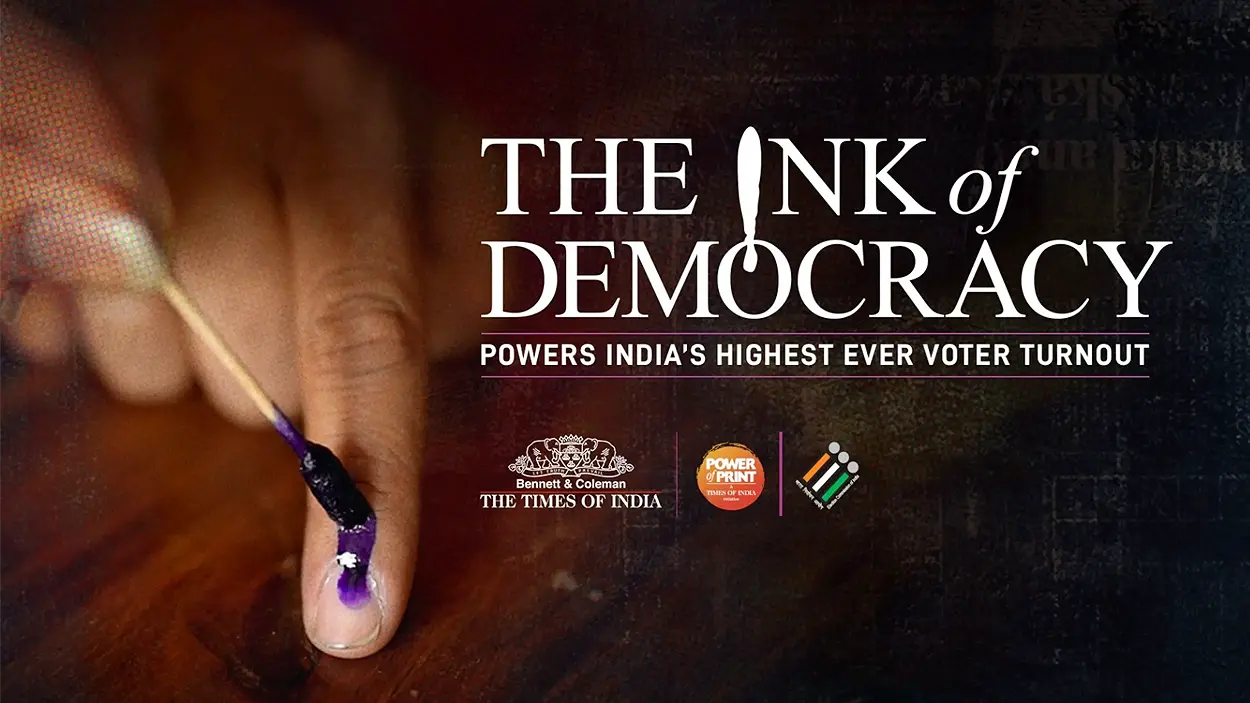
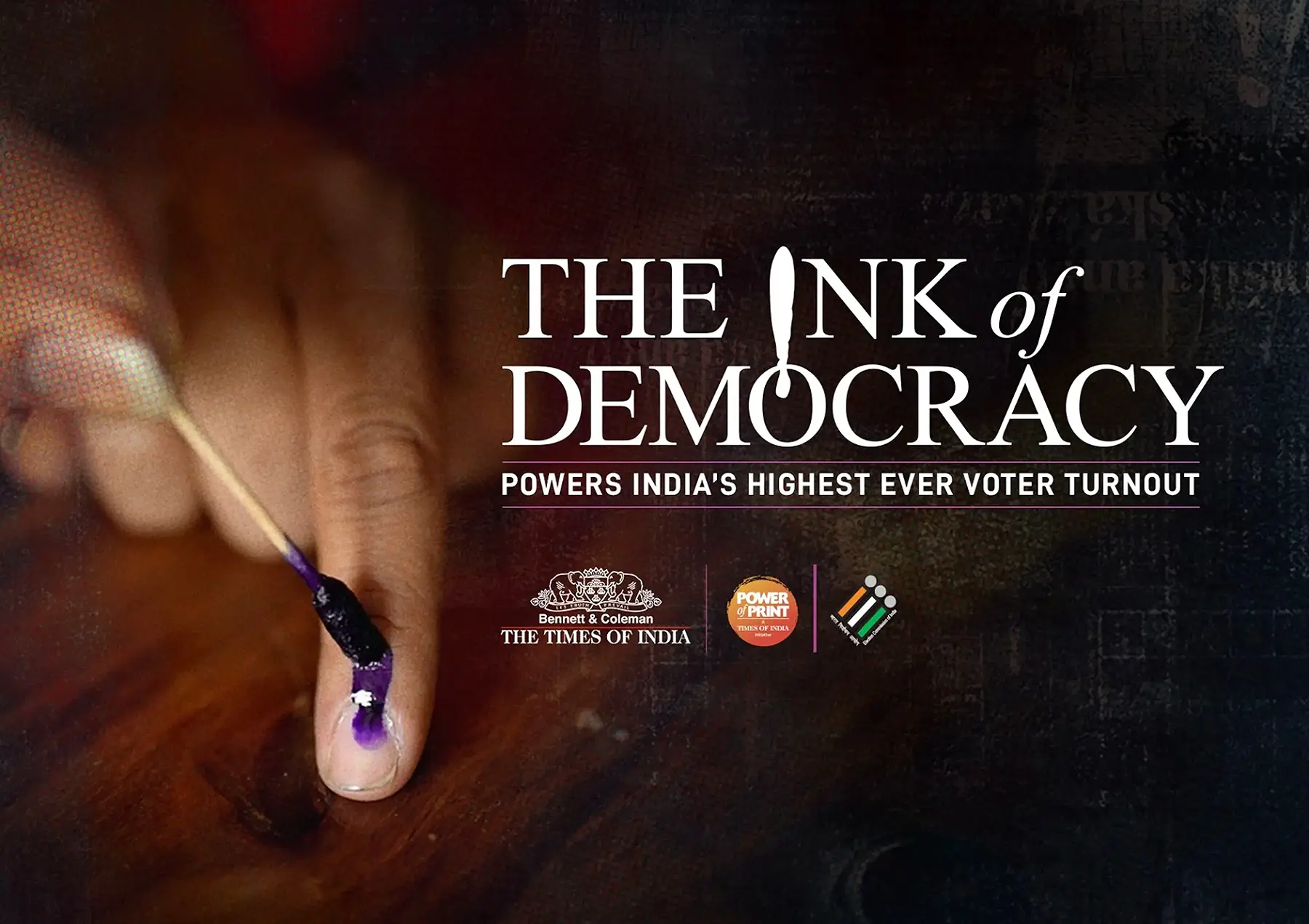
The Times of India took one of India’s most recognisable election symbols and moved it from the polling booth to the newspaper page. Ink of Democracy campaign, created with Havas Creative India for the 2024 Indian General Elections, used purple ink in print to speak to voters before they reached the polling station.
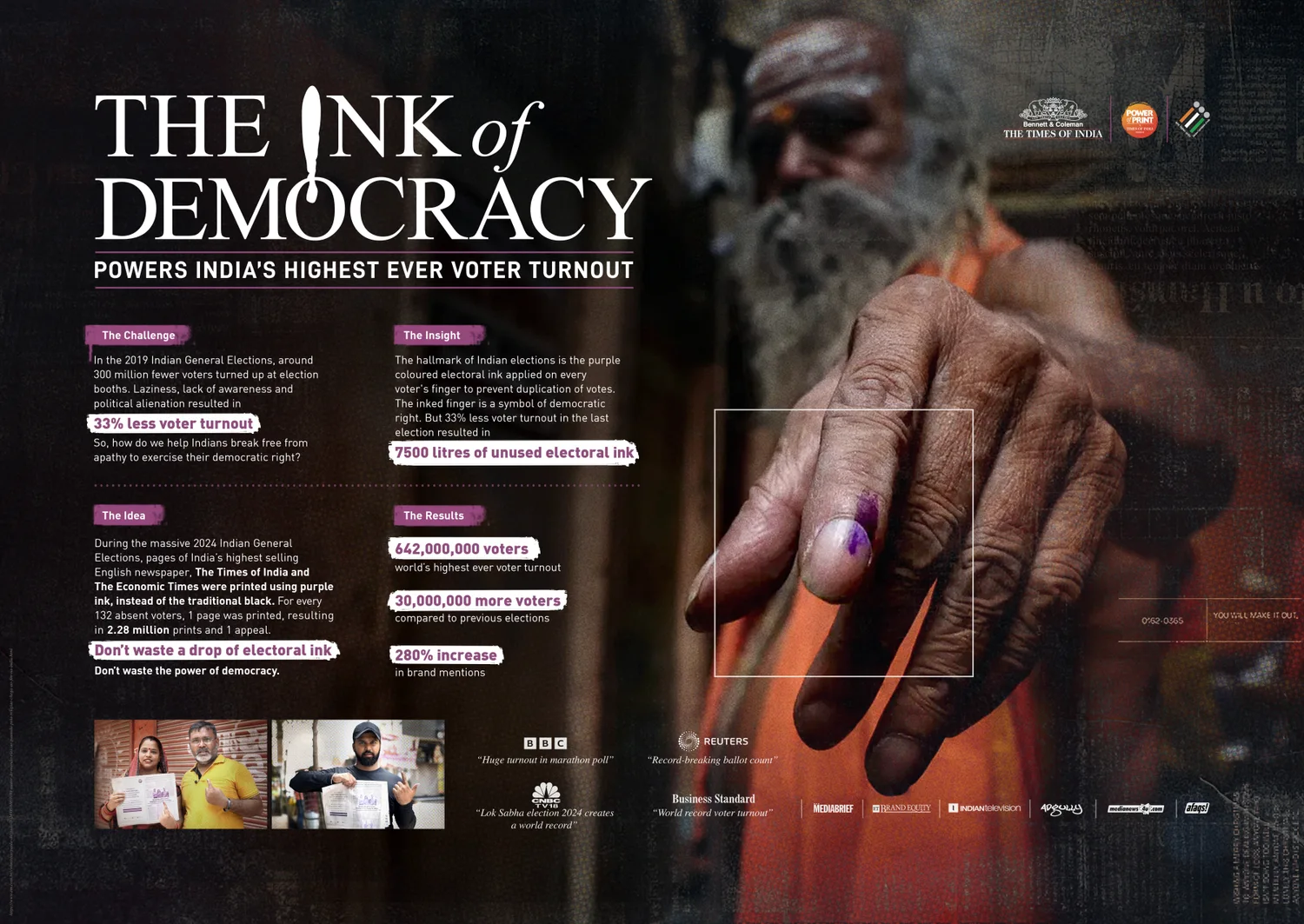
The campaign was based on a simple but uncomfortable fact. In the previous Indian General Elections, around 33% of eligible voters did not vote, according to the campaign entry listed by The One Club for Creativity. The reasons included laziness, lack of awareness and political alienation. The campaign linked that absence to 7,500 litres of unused electoral ink, the purple ink used to mark voters’ fingers and prevent duplicate voting.
A print campaign built around a national symbol
The Times of India and The Economic Times printed pages in purple ink instead of the usual black. For every 132 absent voters, one page was printed. The campaign reached 2.28 million prints with one direct appeal: “Don’t waste a drop of electoral ink. Don’t waste the power of democracy.”
The idea worked because the colour already had meaning. In India, the purple ink mark is widely understood as proof of voting. By putting that colour onto a newspaper page before voting day, the campaign changed its role. It was no longer a mark of participation. It became a reminder of what gets wasted when people stay away.
The execution was released across Delhi, Mumbai, Bengaluru and Kolkata, just before those cities were scheduled to vote. That timing mattered. The campaign was not trying to create general awareness over a long period. It was designed to reach people close to the moment of decision.
Why Ink of Democracy campaign feels effective
Ink of Democracy campaign is a strong print idea because it does not over-explain itself. The campaign uses the medium as the message. Purple ink was not an aesthetic choice. It carried the entire argument.
The audience choice also made sense. The campaign entry notes that urban voter turnout had lagged behind rural turnout, making an English newspaper a relevant medium for the appeal. For readers in major metros, the message landed in a familiar daily format, but with one unusual visual change.
There is a restraint to the work that helps it. It does not shout at voters. It does not rely on a celebrity face or a heavy emotional script. It uses absence as the starting point, then turns that absence into something visible.
A smart use of waste as a creative trigger
Voter apathy is usually discussed through numbers. Percentages can feel distant. Ink of Democracy gave the issue a physical form.
The thought behind the campaign is clear: electoral ink exists only when citizens vote. If people do not turn up, that ink remains unused. By printing pages in purple, the campaign created a visual connection between wasted ink and wasted democratic power.
That makes the campaign more than a topical election message. It becomes a piece of civic communication built from a material associated with voting itself.
The line “Don’t waste a drop of electoral ink” is also doing useful work. It keeps the campaign grounded. It does not make a grand claim about changing democracy. It simply reminds people that participation is the point.
Recognition and reported impact
Ink of Democracy received notable industry recognition. Branding in Asia reported that Havas Creative India won India’s first Gold Lion at Cannes Lions 2025 for the campaign, created in partnership with The Times of India. The same report notes that the campaign won in the Print & Publishing category and centred on the symbolic power of electoral ink.
The One Show lists Ink of Democracy as a 2025 Direct Marketing winner in the Print category, with Havas Creative India, Bennett Coleman & Co Ltd, Mr Pink Music and Galloping Horse Production Pvt Ltd credited on the campaign. The One Show entry also reports 2.28 million prints, 642 million voters in India’s 2024 election and a 280% increase in brand mentions across social media with high positive sentiment.
Those reported results should be read carefully. Voter turnout depends on many political, social and logistical factors. The campaign’s strongest achievement is creative and editorial: it found a way to make not voting visible, using a medium and a symbol people already understood.
Credits
Brand: The Times of India
Campaign Name: Ink of Democracy
Agency: Havas Creative India
Client / Brand: Bennett Coleman & Co Ltd
Production Company: Galloping Horse Production Pvt Ltd
Music / Sound Production Company: Mr Pink Music
Chief Creative Officer: Anupama Ramaswamy & Joji Jacob
Creative Director: Soham Ghosh, Ravinder Kumar, Marcelo Bruzessi & Neha Sidhra
Director: Sophie Lacheze & Annie Joshi
Executive Creative Director: Joao Medeiros & Nazly Kasim
Global Chief Creative Officer: Stephane Xiberras
Photographer: Harmeet Singh Sana
This campaign is about:
Ink of Democracy campaign, The Times of India print campaign, Havas Creative India campaign, Indian election print campaign, electoral ink campaign, newspaper advertising campaign, voter awareness print ad, democracy campaign India, Cannes Lions print campaign, award-winning print ad, creative newspaper ad, social impact print campaign, Creative Print Ad, Creative Print Ads, Print Advertising, Print Campaign, Election Campaign, Voter Awareness Campaign, Democracy Campaign, Electoral Ink, Purple Ink Campaign, Indian Advertising, The Times of India, Havas Creative India, Ink of Democracy, One Show Winner.