A furniture campaign can be ready for a pitch long before the product is ready for a photoshoot. The design is approved, the launch date is fixed, and the creative team is expected to present a convincing picture of something that may exist only as a CAD file and a collection of fabric samples.
It is a familiar challenge in product marketing. Furniture makes the problem particularly clear, but the same gap between design and production can affect lighting, home accessories, appliances and other products.
Waiting for a physical sample is one option. Another is to develop the campaign visuals in 3D, using the information available during product development. The approach has its own demands, but it gives agencies another way to work when production schedules and marketing deadlines do not line up.
When the product isn’t ready
Traditional product photography depends on having something to photograph. Once a sample is available, a team can arrange the set, work with a photographer and stylist, and capture the product under controlled lighting.
The difficulty comes when a campaign needs to be developed before that point. A delayed sample can leave little time for production, particularly when the brief calls for several colours, configurations or formats.
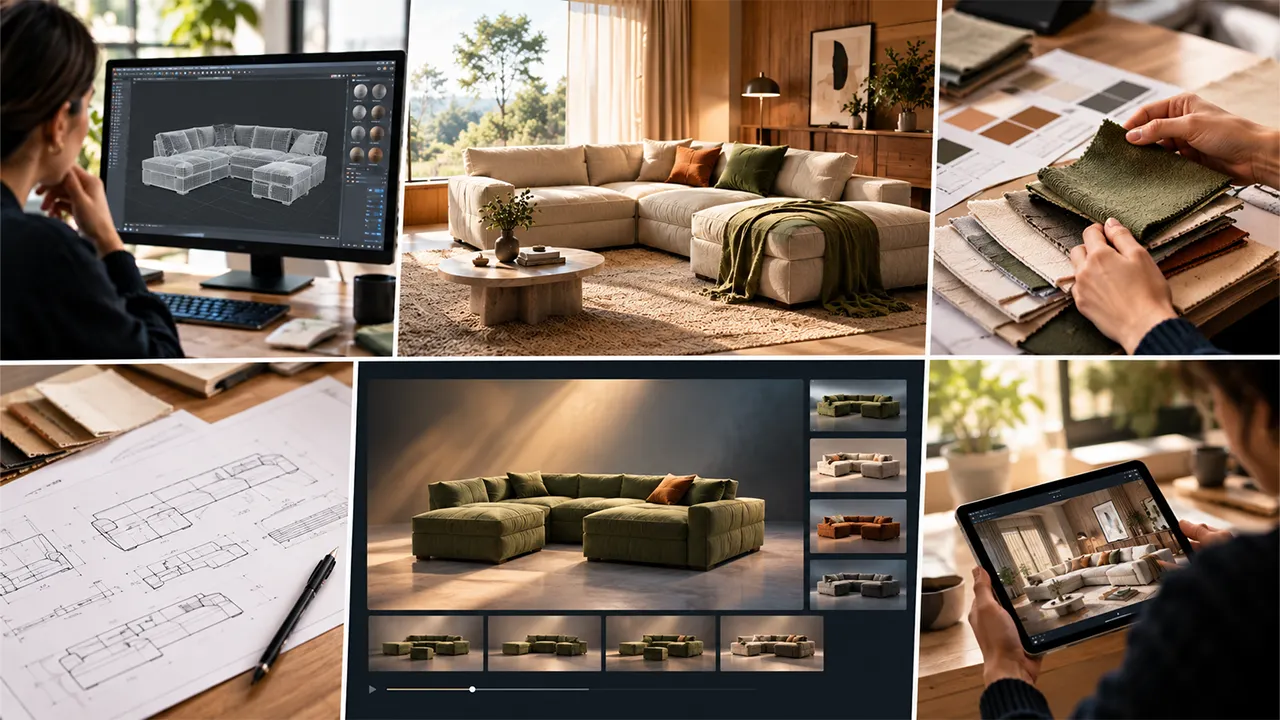
CGI offers an alternative. A 3D artist can build a digital model from suitable CAD files, technical drawings and product specifications, then develop the scene and lighting around it. Material references help establish the intended appearance of the finish.
The quality of the result depends on the information available, the complexity of the product and the skill of the production team. Missing dimensions or unclear material specifications can create problems later, so the brief needs to be clear about what is confirmed and what is still subject to change.
More flexibility, with a few conditions
One advantage of building a product in 3D is the ability to develop different views and variations from the same model.
A modular sofa, for example, might need to appear in several arrangements or upholstery colours. If the model and materials have been set up appropriately, the team can explore those variations without arranging a separate physical shoot for each one.
The same principle applies to campaign environments. A room can be designed once and adjusted for different compositions, lighting conditions or formats. Selected assets can also be animated for short videos, provided the scope and production time allow for it.
That flexibility should not be confused with instant production. Complex materials, new geometry, additional camera angles and substantial changes to an animation can all require further work. Agencies should agree on the expected deliverables and revision process before production begins.
Briefing an external CGI team
Most creative agencies do not need to produce every part of a campaign in-house. Depending on the project, an external specialist may provide the modelling, rendering or animation while the agency leads the concept and client relationship.
A white-label CGI production partner can support this arrangement, with the scope of the partnership agreed between the agency and studio. Before work begins, both sides should be clear about responsibilities, delivery dates, revision limits, confidentiality and the rights associated with the finished assets.
The brief is where much of the work is won or lost. “Premium” or “aspirational” may describe the desired mood, but those words alone leave plenty of room for interpretation. References for lighting, camera angles, interior styling, composition and material appearance give the team something more concrete to work from.
Product information matters just as much. CAD files, dimensions, technical drawings, colour references and fabric samples can all help the studio understand what needs to be represented accurately. If a specification is provisional, identify it as such rather than allowing an assumption to become part of the final image.
Treat art direction as part of production
A technically accurate model does not automatically make a compelling campaign image. The room can feel sterile, the lighting can flatten the material, or the styling can distract from the product.
This is why agencies should remain closely involved in art direction, even when the rendering is handled externally. Decisions about framing, light, props, texture and atmosphere should support the original creative idea rather than simply make the image look polished.
Material accuracy deserves particular attention. Fabric can look different under different lighting conditions, and a digital texture may not fully capture the appearance of a physical finish. Scanned references and actual samples can help, but the result should still be checked against the approved specification.
When the first production sample becomes available, comparing it with the render can reveal differences that need correcting. It is better to resolve those details before final assets are approved for print or other fixed-format applications.
Plan the revisions before the first render
A CGI project needs room for review. The first set of images may reveal that the fabric looks too smooth, the room is too bright or the product needs to be shown from another angle.
Agencies should establish review milestones and agree on how feedback will be consolidated. It also helps to distinguish minor adjustments from changes that affect the underlying model or require new deliverables.
A realistic schedule accounts for the time needed to review the work, return consolidated comments and approve the final assets. A tight launch date is not a substitute for a workable production plan.
The brief should also cover the full range of required outputs. A hero image, a social crop, a product-page visual and an animated sequence may need different compositions or production work. Identifying those needs early reduces the risk of discovering a missing asset close to launch.
CGI and photography can work together
CGI does not make photography obsolete. A physical shoot can capture real people, natural interactions and the character of an actual space in ways that may be important to a campaign.
The two methods can also serve different stages of a launch. Rendered imagery may be useful while a product is still in development or when multiple approved configurations need to be shown. Photography can follow when samples are available and the campaign calls for real environments or people.
The right mix depends on the brief, the product, the available reference material, the budget and the delivery schedule. Neither approach is automatically the better choice for every campaign.
Four questions to ask before production starts
When a brief arrives before the product is ready, four questions help establish whether CGI is a practical option:
- What information is available? Confirm the CAD files, drawings, measurements, material samples and approved colour references.
- When will physical samples arrive? Build in time to check the renders against the finished product where necessary.
- Which variations are essential? Agree on the required configurations, colours, camera angles and formats before production begins.
- Who is responsible for art direction and approval? Establish who briefs the studio, consolidates feedback and signs off the final assets.
A product that is not yet available for photography does not necessarily have to stop a campaign from moving forward. With reliable product information, clear art direction and a realistic production plan, CGI can give agencies another way to develop launch visuals before the physical product is ready.
The important decision is not whether every campaign should use 3D. It is whether the method suits the product, the creative idea and the time available.