For more than a decade, Clash of Clans players have known one thing with absolute certainty: the Builders are always working. They hammer, repair, upgrade and keep the village moving. The Epic Build campaign takes that familiar habit and breaks it in the most dramatic way possible.
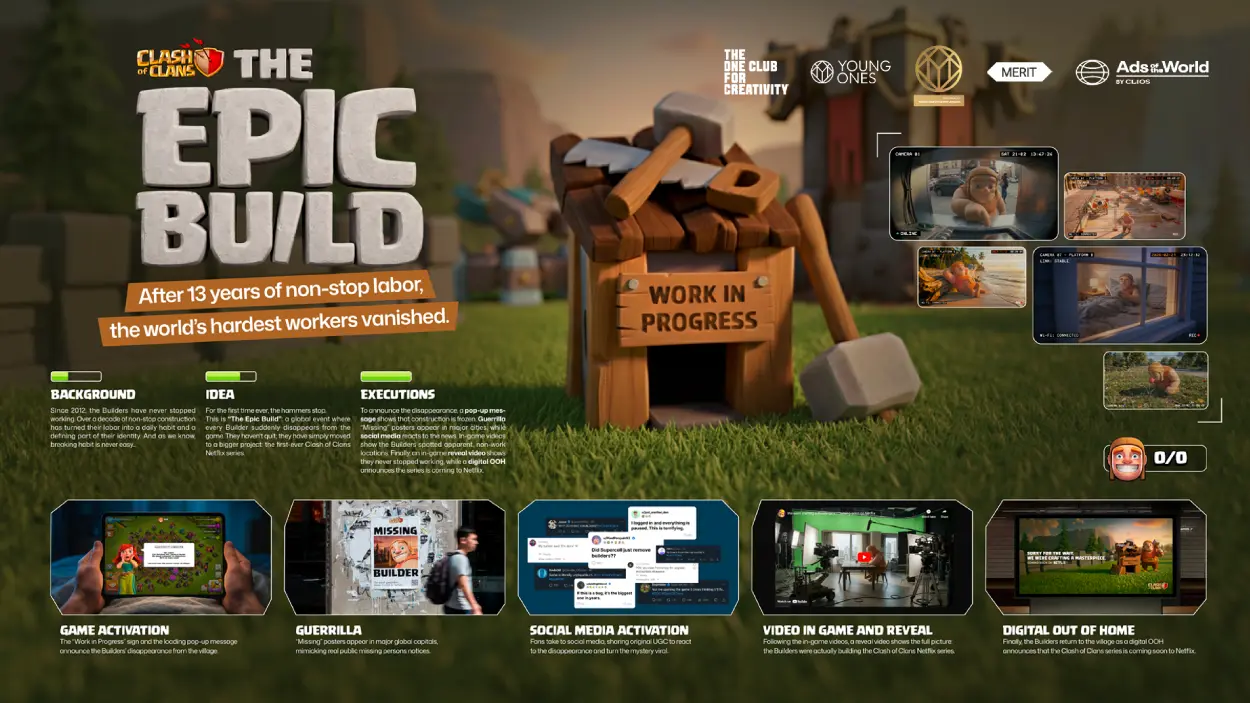
Created by Accademia Delle Arti e Nuove Tecnologie as a student-led concept for Supercell’s Clash of Clans, the idea imagines a global digital and integrated campaign where every Builder suddenly disappears from the game. Construction freezes. Villages go quiet. Players are left with a question that feels strange because it interrupts something so routine inside the game: where did the Builders go?
The answer is built for entertainment culture. They have not quit. They are working on something bigger, the first Clash of Clans original series on Netflix.
A gaming habit becomes the campaign trigger
The smartest part of The Epic Build campaign is that it does not begin with an ad. It begins by interrupting player behaviour.
In Clash of Clans, building is not a side feature. It is part of the daily rhythm. Players log in, start an upgrade, wait, return, repeat. The Builder is almost invisible because the role is so constant. By removing that certainty, the campaign gives players a reason to care before any reveal happens.
The in-game pop-up becomes the first crack in the routine. Construction is frozen. The Builders are gone. No long explanation, no heavy launch message, just enough disruption to make players talk.
That is where the idea feels sharper than a standard entertainment tie-in. Instead of placing a Netflix announcement over the game, the campaign makes the game world behave as if something serious has happened inside it.
From missing posters to leaked sightings
The campaign then moves outside the screen. Guerrilla-style “Missing” posters appear in major global cities, treating the Builders like real-world characters who have vanished. It is a simple move, but it gives the digital mystery a physical presence.
The same idea continues through social media, where leaked-style videos show the Builders in ordinary places away from the village. They are not upgrading walls or working on defenses. They are seen in everyday, non-work settings, which adds humour without breaking the mystery.
This is where the campaign earns its integrated label. The pieces are not random touchpoints. Each one carries the same question forward. The game freezes the action. The posters make the disappearance public. The leaked videos turn the Builders into characters people can follow.
The Netflix reveal lands because the silence was staged first
The campaign’s final reveal explains the disappearance through an immersive in-game video and digital OOH billboards in iconic locations. The Builders were never missing. They were building a new reality on Netflix.
That line of thinking gives the campaign a clean payoff. It links the act of building, the Builders’ identity and the launch of a new entertainment property in one move. For a brand like Clash of Clans, which already has a rich visual world and recognisable characters, the idea makes sense because it does not need to borrow attention from outside. It uses something players already understand.
The Epic Build campaign also avoids the usual trap of game-to-screen promotions. It does not simply say a series is coming. It stages the announcement as an event inside the game’s own logic. For players, the reveal feels like a continuation of the experience, not a separate marketing push.
Why the idea works for Clash of Clans
Clash of Clans has always been about progress, waiting, upgrading and planning. The Builders sit at the centre of that loop. By making them disappear, the campaign creates a temporary absence that players would immediately notice.
That absence is the hook.
The campaign understands that long-running games are full of habits, and habits can become media moments when they are disrupted with care. It also gives the Builders a bigger role than usual. They are no longer background workers. They become the face of the story.
For a Netflix series reveal, that shift is useful. It turns a functional game mechanic into an emotional and narrative device. Players are not just told to watch something. They are invited to solve a mystery that begins in a place they already visit.
A student concept with a real brand-world instinct
As a student-led concept, The Epic Build campaign carries the confidence of a major entertainment launch. It feels built for a fandom that enjoys clues, speculation and playful disruption.
The campaign also shows a strong understanding of how modern gaming audiences respond. They do not only consume announcements. They screenshot, decode, share, joke and react in real time. A frozen village, missing posters and leaked Builder sightings all give them material to work with.
The strongest lesson here is simple: when a brand has a living world, the best campaign may not sit outside it. It may come from changing one familiar detail and letting the audience feel the difference.
Credits
Brand: Supercell
Product: Clash of Clans
Campaign Name: The Epic Build
Advertising Agency (School): Accademia Delle Arti e Nuove Tecnologie
Creative Supervisor: Giulia Magaldi
Art Director: Alessandro Arnold, Matteo Sinopoli
Motion Designer: Carlo Renato Popescu
Category: Digital and integrated campaign