Most people know what to type when they need an answer.
But what do you type when you have a problem and are not even sure where to start?
That is the more interesting question behind Google India’s new campaign, ‘Google Search – Samjhe. Samjhaaye. Raah dikhaye.‘
Developed in collaboration with McCann India and conceptualised and written by Prasoon Joshi, the campaign introduces AI Mode in Google Search through a situation that has very little to do with technology at first glance. Google’s official announcement provides more detail on how the feature works.
And that is exactly why the film works as a product story.
Karan Has a Café Dream. Telling His Father Is the Hard Part.
The film follows Karan, a young man preparing for competitive exams who has another ambition on his mind: opening his own café.
There is just one problem. He does not know how to tell his father.
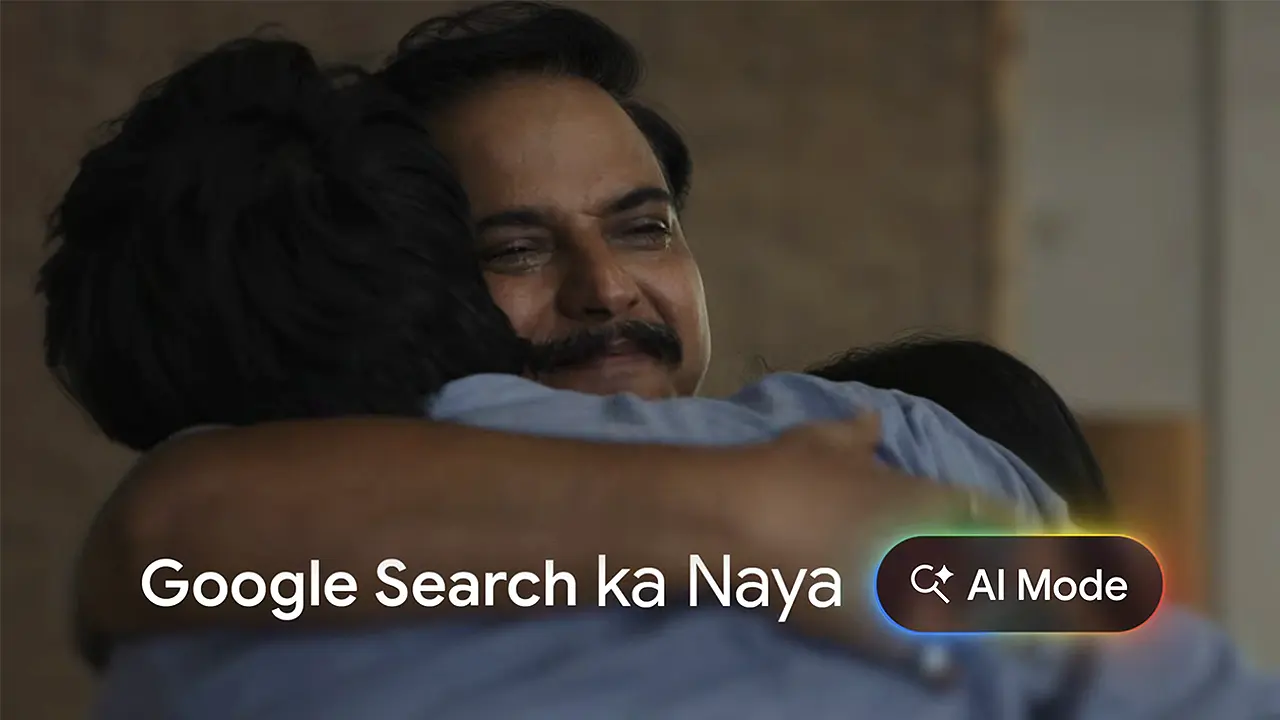
Instead of beginning with a conventional product demonstration, the film starts with this very human uncertainty. Karan turns to AI Mode in Google Search and asks how he should approach the conversation and where he should begin.
That question then leads to another.
And another.
Soon, the conversation moves beyond how to tell his father and into the practical reality of the business. Karan begins thinking about what students around him might need, what his café could offer and where financing could come from.
The interesting bit is that the original question changes as Karan thinks things through.
That is the behaviour Google is really selling.
The Best Question Is Sometimes the One You Ask Next
Traditional Search is often associated with a specific query and a specific answer, a territory Google has explored creatively before in Google – Easy Questions Don’t Always Have Easy Answers.
The situation in this film is different.
Karan does not arrive with a neatly defined problem. He arrives with an idea, some uncertainty and a lot to figure out.
AI Mode gives him room to keep going, much like the conversational experience explored in Google Assistant and Artificial Intelligence
The conversation can become longer, more specific and more practical as his thinking develops. Instead of forcing him to know exactly what to search for, the interaction helps him explore the problem one step at a time.
That makes the technology easier to understand without having to explain the technology too much.
Google is essentially saying: you do not always need to know the right question before you start.
Google has explored the cultural side of search before, notably through The Most Searched, which turned real search behaviour into the centre of its creative idea.
From “What Should I Say?” to “How Would I Actually Do This?”
This is where the film finds its strongest creative progression.
Karan’s first concern is personal. How does he talk to his father?
But once that is addressed, a bigger set of questions appears. If he really wants to open a café, who would use it? What would they need? How could he finance it?
The film turns that progression into the product demonstration.
There is no dramatic AI reveal. No futuristic interface takes over the story. No long explanation of features.
Instead, the audience watches one question lead naturally to the next.
For a campaign about conversational AI, that is a smart way to make the interaction understandable.
It also sits within a broader evolution of technology-led campaigns on Campaigns of the World, where the technology works best when it becomes part of the experience rather than the entire story.
Google Doesn’t Make AI the Hero. Karan Does.
There is a temptation with AI advertising to spend too much time showing what the technology can do.
This film takes the opposite route.
AI Mode is almost a supporting character. Karan remains at the centre.
We understand why he is searching before we think about what the technology is doing. His ambition gives the feature a reason to exist.
That choice also keeps the film grounded. The campaign is not asking viewers to be impressed by AI. It is asking them to recognise a familiar feeling: having something you want to do, but not knowing how to turn the thought into a plan.
A Product Demonstration Disguised as an Everyday Conversation
The film’s biggest strength is the way it hides its product demonstration inside the story.
Karan’s conversation with AI Mode gradually reveals what the feature is designed to do. Longer questions, follow-ups and practical exploration are all demonstrated through his situation rather than listed as features.
That makes the film easier to watch and easier to understand.
It also gives the campaign a useful creative territory for the films that follow. The first story establishes the idea that Search can help when the problem itself is still taking shape. Future films can build on that territory with different moments where people need help thinking through what comes next.
The Real Idea Is Not AI. It Is What Happens After the Question.
For us at Campaigns of the World, the most interesting thing about this campaign is not the AI itself. It is the change in the role Google Search is trying to occupy.
Karan is not simply looking for information. He is trying to make a decision. The campaign therefore moves Search into a space that feels closer to thinking, planning and exploring.
That is a more interesting advertising proposition than simply saying, “Google Search is now powered by AI.”
The film also gets the tone right by keeping the technology relatively quiet. The human problem comes first, and the product earns its place in the story. Karan’s uncertainty gives AI Mode a genuine role rather than making the technology the star of the film.
The clever part is that Google does not try too hard to explain AI Mode. Instead, we watch someone use it to work through a problem. That makes the product feel useful rather than impressive for the sake of being impressive.
There is a bigger creative challenge ahead, though. This is the first film in a series, so the idea will become more interesting if the following stories find equally specific human situations rather than simply repeating the same AI Mode demonstration.
For now, the campaign has found a simple way to make a complicated product idea understandable: sometimes you are not searching for an answer. You are searching for your next step.
Credits
Brand: Google
Agency: McCann India
Conceptualised and Written By: Prasoon Joshi
Creative: Ashish Nath, Anshuman Singh, Dushyant Chopra, Sujan Sarkar
Business: Dheeraj Sinha, Kamal Basu, Tanisha Sharma, Siddharth Bhattacharya, Sankalp Srivastava, Saurabh Awana
Strategy: Sumeer Mathur
Films: Jitender Kalra, Sameer Relia
Production House: Chrome Pictures
Director: Amit Sharma