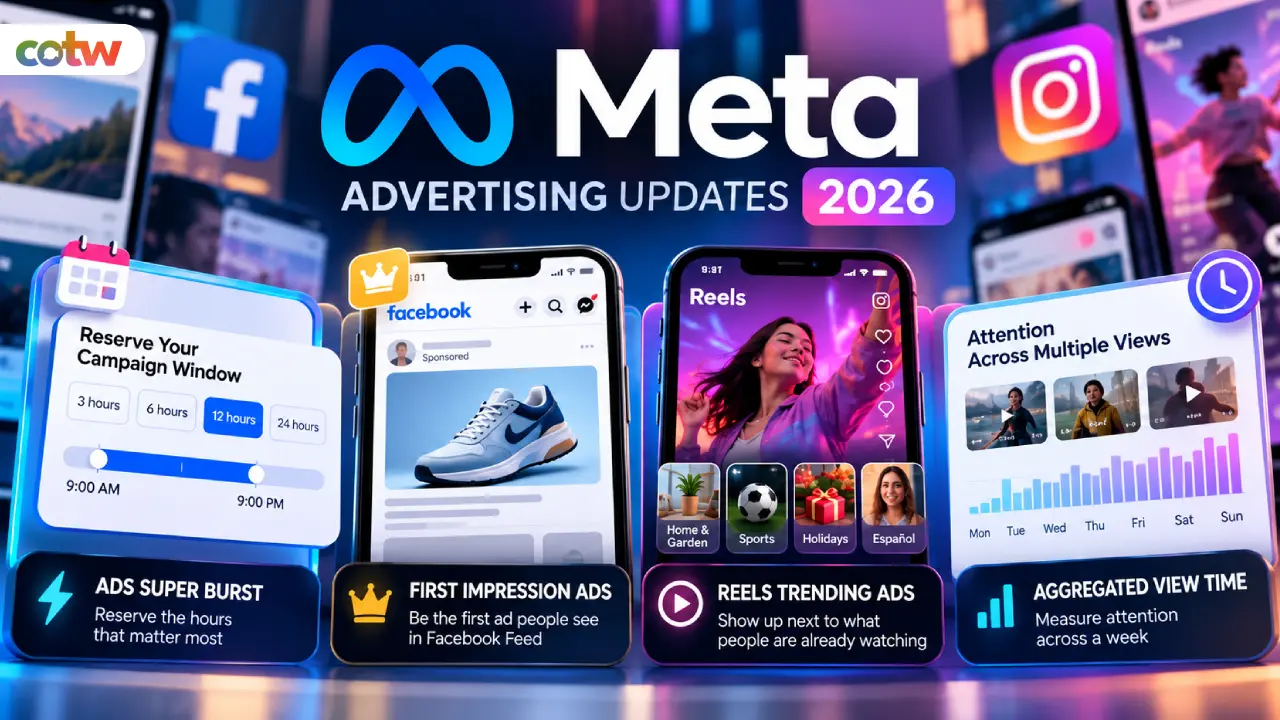
Meta is introducing new ways for brands to plan concentrated advertising campaigns, secure prominent placements and measure attention across short-form video. Announced at its Brand Building Summit on October 15, 2026, the updates cover four areas: Ads Super Burst, First Impression Ads, Reels Trending Ads and Aggregated View Time. Meta’s official Brand Building Summit announcement outlines the changes..
The changes address different stages of brand advertising, from deciding when an ad should run to understanding how people engage with video content over time. Here is what each update introduces and what advertisers need to know.
Ads Super Burst Reserves a Concentrated Advertising Window
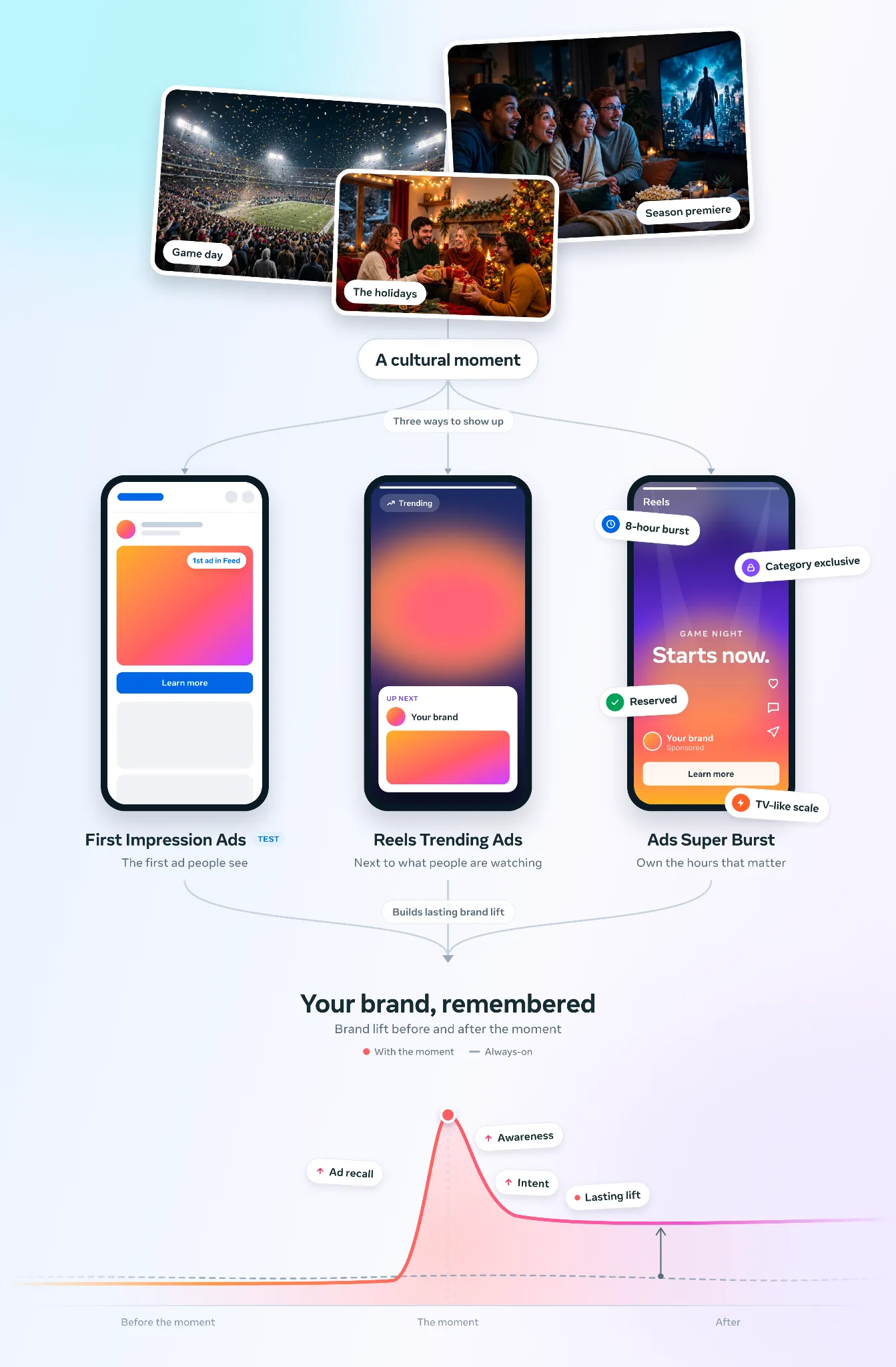
Ads Super Burst is a new advertising option that allows brands to reserve a campaign window lasting between three and 24 hours. It is designed for occasions when timing matters, such as a product launch, an awards night or the opening weekend of a sports season.
Advertisers can plan bookings through Meta’s Reach Planner, which provides estimated reach and pricing for their selected dates. The product also offers category exclusivity, preventing another advertiser in the same category from booking the same window.
Meta says Ads Super Burst campaigns have guaranteed delivery tied to the estimates provided through Reach Planner. This gives advertisers a way to plan concentrated exposure around a specific moment rather than spreading a campaign across a longer period.
According to Meta, advertisers testing the format over the preceding months recorded a median 2.9 percentage-point lift in ad recall and a 0.6 percentage-point lift in intent. Each campaign flight reached a median of 34 million people, equivalent to 14% of the US adult online audience in a single day, according to the company’s figures.
These are results reported by Meta from early campaigns, not guaranteed performance benchmarks for every advertiser. Ads Super Burst is moving towards general availability in October 2026 through a phased rollout.
First Impression Ads Tests the First Advertising Position in Facebook Feed
Meta is testing First Impression Ads in the United States, giving one brand per day the opportunity to appear as the first ad someone sees when opening the Facebook app and encountering Feed.
The placement is designed around prominence. Rather than competing with other advertisements further down the feed, a brand gets the first advertising position. Meta says advertisers have asked for this type of placement for years, and the company is now testing the product in response to that demand.
The test remains limited, with just one brand per day. Meta has not announced broad availability in the supplied announcement, so advertisers should not assume they can currently book the placement.
Reels Trending Ads Expands Its Content and Targeting Options
Reels Trending Ads is an existing product that lets businesses place advertisements immediately after the most-watched and most culturally relevant Reels on Facebook and Instagram. Meta expanded access to the product to all advertisers in 2025 and is now adding more ways to select the cultural moments surrounding a campaign.
Advertisers can choose from 15 always-on standard topics. New categories include Home & Garden and Spanish-language content, alongside seasonal line-ups built around occasions such as holidays and the start of football and basketball seasons.
Meta is also expanding the product’s targeting capabilities. Custom audience exclusions are planned for later in 2026, giving advertisers another way to control who they reach through campaigns using Reels Trending Ads.
The company reports that campaigns incorporating the product recorded an increase of more than five percentage points in action intent compared with control groups that had not been exposed to the campaigns. Meta also reported an incremental five percentage-point lift in unaided brand awareness.
These findings are based on Meta’s reported campaign results. They do not establish that every advertiser will achieve the same improvements, and the announcement does not provide enough methodological detail to independently assess the results.
Aggregated View Time Looks at Attention Across Multiple Exposures
Meta is also testing Aggregated View Time, a product designed to measure and optimise the total time someone spends with a brand over a week, rather than evaluating each video impression separately.
The idea reflects how people consume short-form video. Someone might see a brand for two seconds in a feed, encounter it for another second the following day and watch for two more seconds later in the week. Aggregated View Time is intended to consider those interactions together.
Meta says its research found that five seconds of accumulated attention over a week drove 32% more offline sales than a single, continuous five-second view. The company also cites independent industry research that found accumulated viewing time could predict outcomes better than focusing on one long view.
These findings concern the relationship between accumulated attention and sales outcomes. They should not be interpreted as proof that repeated exposure alone causes higher sales in every campaign.
Aggregated View Time remains in an early alpha testing phase. Meta describes it as an approach it is still developing, rather than a fully available measurement product.
More Advertising Options, but Attention Still Has to Be Earned
The four updates serve different purposes. Ads Super Burst lets advertisers reserve a concentrated campaign window. First Impression Ads tests a premium position at the start of Facebook Feed. Reels Trending Ads expands the topics and targeting choices available for contextual placements. Aggregated View Time explores how attention accumulates across multiple video encounters.
For media planners, these changes create additional ways to organise exposure around a campaign objective. For creative teams, however, the underlying challenge remains the same: securing a placement is not the same as earning attention.
A reserved window can help a brand show up at a relevant moment, but it cannot make an uninteresting message memorable. A first-position ad offers prominence, while Reels Trending Ads provides more control over the content surrounding a placement. Neither removes the need for a strong creative idea that gives people a reason to engage.
This is also why the relationship between media planning and creative execution matters. Campaigns such as Volvo XC40’s Drive-In Movies show how a brand can build an idea around an experience and extend it across digital platforms. The lesson is not that every campaign needs a premium placement, but that the placement works best when the creative gives people something worth remembering.
The availability of Meta’s new products also varies. Ads Super Burst is moving towards general availability through a phased rollout, First Impression Ads is being tested in the United States, and Aggregated View Time remains in alpha. Advertisers should confirm access and product terms before including these options in their media plans.
Meta’s latest updates offer brands more control over campaign timing, placement and the measurement of video attention. Their longer-term value will depend on whether these tools help advertisers connect with the right audiences and create work that people remember. Explore more examples in Campaigns of the World’s digital campaigns collection.